
Invisible, Yet Essential
Compressed air may be unseen, but in glass manufacturing it is the silent force that shapes, cools, and powers every stage of the process. Hollow glass plants often operate with a two-pressure setup - low and high - and each demands air with minimal contaminants to keep production moving and products flawless.
Maintaining optimal glass manufacturing air quality requires specialized components like compressed air filters and air dryers to help support air quality in the process and safeguard product consistency.
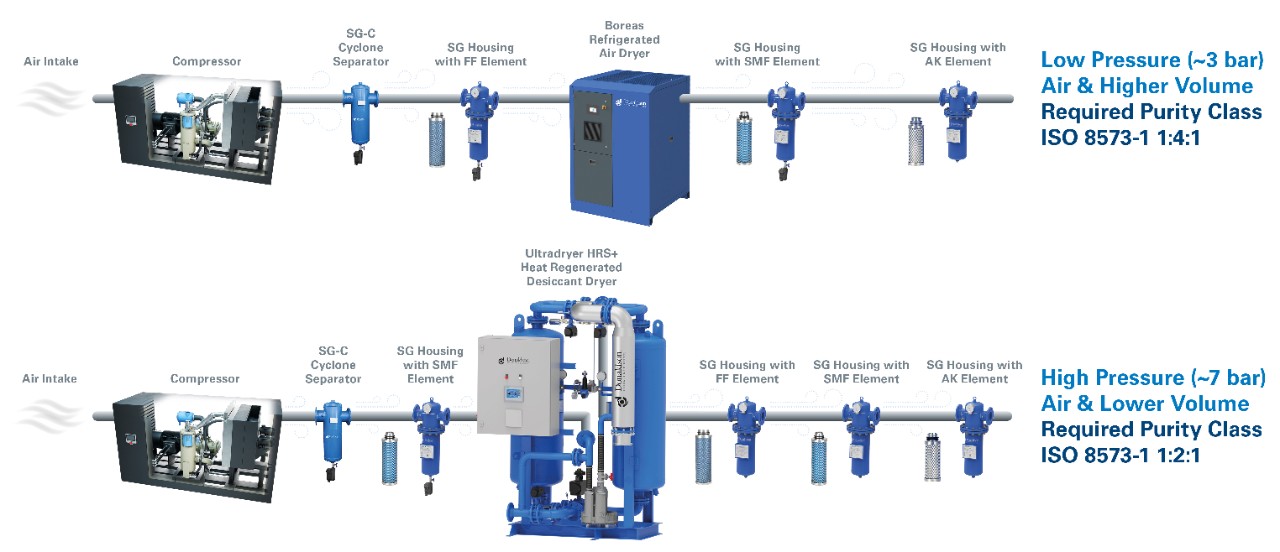
Low-Pressure Air: Volume That Shapes and Cools
At around 3 bar, low-pressure air is used for gob settling and pre-blowing to shape the parison –the intermediate form of the container. The gentler air pressure helps protect molds from damage during forming while providing the high volumes needed for cooling and cleaning. Producing air directly at low pressure avoids unnecessary energy use, with purity typically aligned to ISO 8573-1 Class 1:4:1 (Class 1 for particles, Class 4 for water, Class 1 for oil).
High-Pressure Air: Precision That Drives Control
At roughly 7 bar, high-pressure air provides the final blow after transfer, defining the piece’s detailed features and form. Compressed air also powers automation systems, counter-blowing, and plunger mechanisms that demand precise, reliable control. These systems are designed to match demand accurately, with air quality often defined by ISO 8573-1 Class 1:2:1, supporting clean, dry, and oil-free operation.
Beyond Forming: Air Across the Entire Process
In addition to the forming cycle, clean compressed air supports multiple steps throughout glass manufacturing, from mold cooling and lehr control to handling, cutting, and facility automation - making it an indispensable utility across the plant.
When Air Isn’t Pure, the Results Are Immediate
Even minor contamination in compressed air can have a visible and costly impact.
Low-pressure side: Moisture or oil vapor carried into the blowing and pressing stages can cause glass to stick to molds, create surface blemishes, or weaken the product’s structure. Dust or particulates in cooling or cleaning air may scratch or cloud the surface, leading to costly rejects.
High-pressure side: Small amounts of contamination can clog or corrode precision valves, cylinders, and automation systems. This leads to inconsistent counter-blowing, flawed forming cycles, and unexpected downtime. The failure of one plunger mechanism or automation line can halt entire batches, sending valuable production straight to scrap.
Unpurified air doesn’t just compromise quality; it can bring entire processes to a standstill. In an industry where furnaces run continuously and every hour of downtime represents significant production loss, the risks of neglecting proper air treatment are immediate and dramatic.
Donaldson Purification Technologies for Glass Production
Meeting these demands requires tailored air purification technologies that help protect every stage of production:
- Compressed Air Dryers supply clean, dry air with dew points as low as –40 °C (or –70 °C for critical applications), supporting stable operation and helping to protect downstream equipment.
- Coalescing and particulate filters capture moisture, oil aerosols, and solid contaminants to safeguard forming, control, and automation systems.
- Oil-free and breathing air solutions deliver purified, odor-free air for sensitive applications.
Confidence in Every Batch
For glass manufacturers, the value of purified air is clear: consistent product quality, fewer rejects, and greater reliability across every stage of production. With the right filtration and drying technologies in place, manufacturers gain peace of mind that their systems can keep up with the demands of continuous operation.