
Sterile air filters are rated at 0.2 microns for several important reasons:
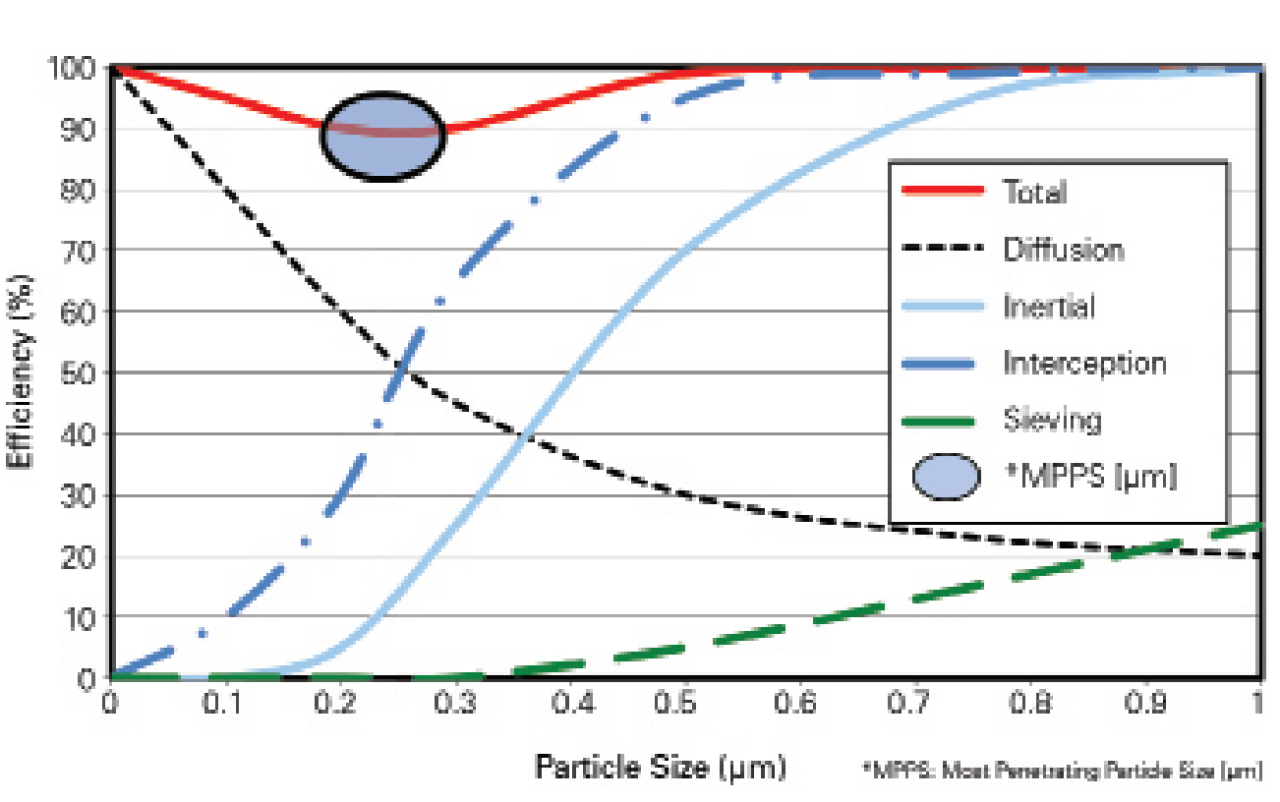
- Optimal Particle Capture: The 0.2-micron size is considered the most challenging particle size to capture. Filters rated at 0.2 microns are designed to efficiently remove particles both larger and smaller than this size. Focusing on this micron size provides a high level of filtration efficiency across a wide range of particle sizes.
- Microorganism Filtration: Many bacteria and other microorganisms are around 0.2 microns in size. By targeting this specific size, sterile air filters can effectively filter these contaminants, providing an air stream that is clean and appropriate for use in sensitive food and beverage applications.
- Filtration Mechanisms: Different filtration mechanisms, such as diffusion, interception, impaction, and sieving, work together to capture particles of various sizes. Filters rated at 0.2 microns leverage these mechanisms to achieve high efficiency in filtering contaminants
- Industry Standards: Rating filters at 0.2 microns aligns with industry standards and best practices, ensuring that the filters meet the stringent requirements for sterile air applications.
 Primary Particle Filtration Mechanisms
Donaldson sterile air filters are rated at and define efficiency at 0.2 microns for a couple of reasons:
As the chart to the right shows, it is easy to achieve very high efficiencies of over 99.9% at a 0.01-micron particle size. Even though a filter can truthfully advertise 99.9% at 0.01 microns, it is quite possible that it is significantly less efficient at 0.2 microns and allowing bacteria through to contaminate the sterile process. Before purchasing sterile air filters, ensure that your supplier provides the efficiency at 0.2 microns.
Diffusion
Diffusion works primarily on small particles <0.1 microns. These small particles are bombarded by air molecules and change directions thousands of times each second. This random motion occurs at various angles to the mean free path of the flow stream and increases the likelihood that these particles will contact a fiber.
Interception
Interception works primarily on particles >0.5 microns that are too large to diffuse often but are not massive enough to have inertia. Airflow is forced to change direction in order to flow around individual media fibers, and particles of medium size will contact these fibers as this flow streamlines past.
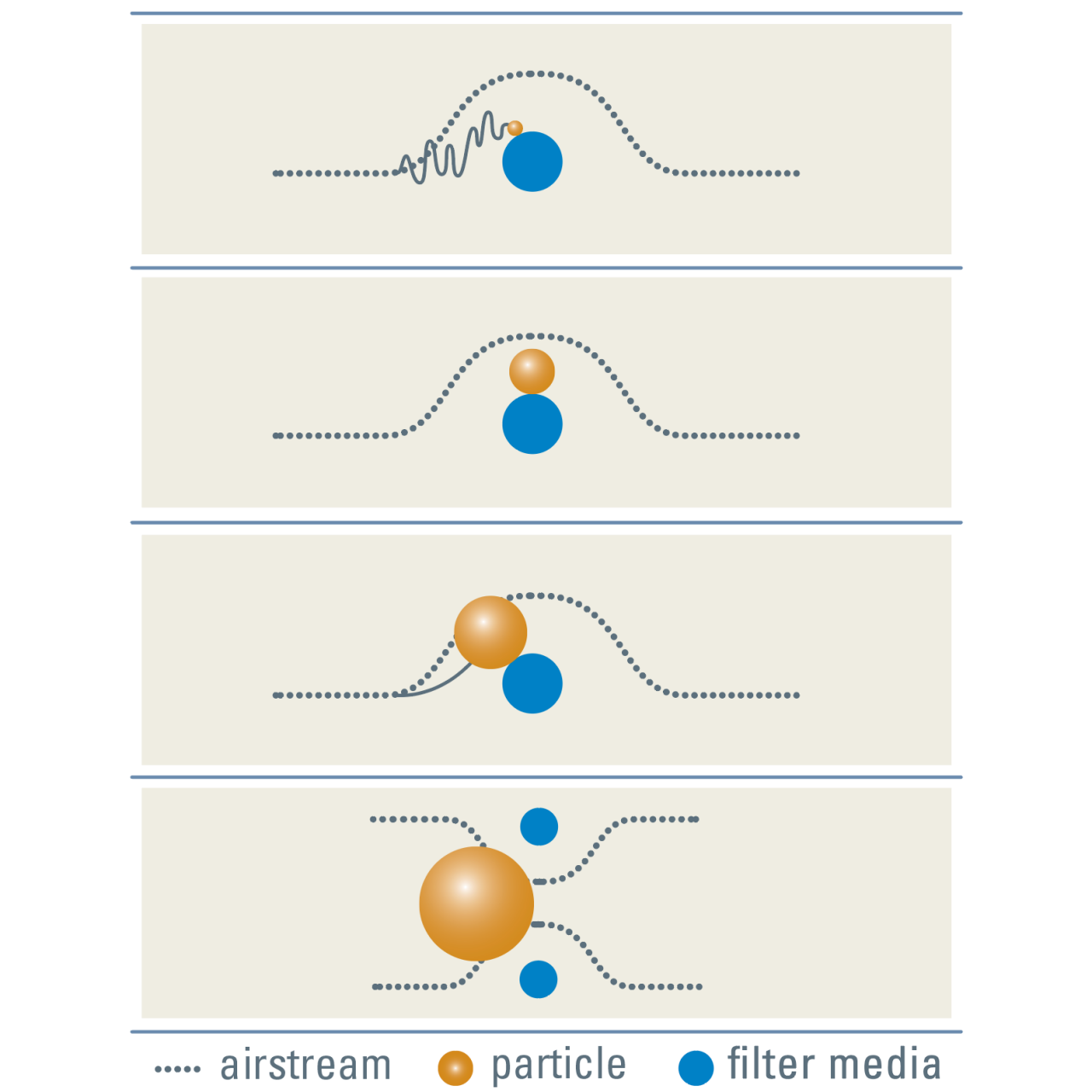
Impaction
Impaction works on more massive particles that cannot maintain the flow path directional changes through the filter. The mass of these particles causes them to fly straight into a fiber as the air changes direction.
Sieving
Sieving works on large volume particles. Their volume is so great that it is not possible for them to fit through the void volumes between fibers. This is the filtration mechanism most people are familiar with.