
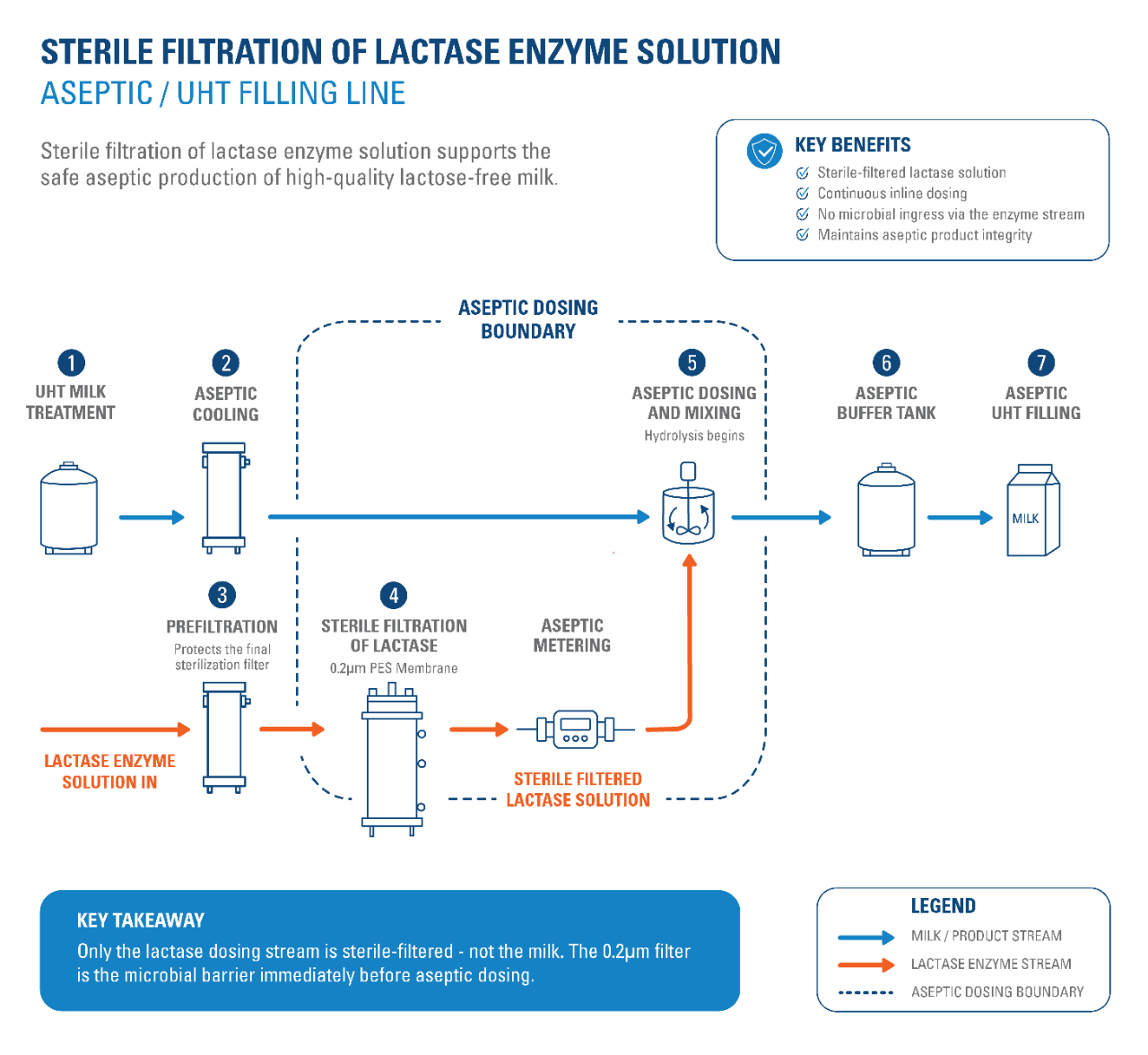
To produce lactose-free milk, lactase can be added to the milk pre- or post sterilization/pasteurization. If it is dosed in afterward, it is imperative that the lactase is sterile filtered to ensure a safe, clean product.
FILTRATION CHALLENGES
Lactase is an enzyme -a protein- that itself is significantly smaller than 0.2 µm, and can pass easily through the membrane. It’s often manufactured and sold in aqueous solutions that are then dosed into the milk, and filtration challenges can arise when other proteins or polysaccharides, are also present in the solution.
There are a few main factors that can make sterile lactase filtration difficult:
- Protein fouling and surface caking that affects membrane throughput and overall time in service- this can lead to premature clogging of the membrane, resulting in more frequent changeouts or unplanned downtime.
- The viscosity of the solution, which is higher than that of water and can reduce flows and filter life, as well as affect overall production efficiency.
- Product loss via adsorption when proteins bind to the membrane- if the selected media tends to hold on to proteins, the resulting enzyme loss can add up over time.
A TESTED SOLUTION
While there are a number of different medias available to use, Polyethersulfone (PES) offers exceptional performance while remaining a cost-effective choice. It allows for reliable, repeatable sterile retention performance while also offering lower protein adsorption.
Donaldson’s latest LifeTec™ release, the PES-WH, is a highly asymmetric 0.2 membrane formulated to provide higher dirt loading capacity with a lower pressure drop across the membrane, resulting in performance that is approximately 1.75 times that of a standard PES while still providing LRV<10 at 0.2 micron.